Blog 24: Access to Indigenous Knowledge
During my career, I heard acquaintances and colleagues express the opinion that engaging with Indigenous Nations meant you would also gain access to Indigenous Knowledge, regardless if you worked for a government, business, college or university institution. They believed that shared Indigenous Knowledge would help inform and support their policy, business, or research decisions. Notwithstanding the genuine interest within those institutions to protect collected Indigenous Knowledge, many Indigenous people still distrust those institutions. That distrust has discouraged, and many times precluded, the sharing of Indigenous Knowledge. When I began to engage with Indigenous people, I learned that the white settler expectation to acquire access to Indigenous Knowledge was naive and unrealistic.
Indigenous Knowledge (IK):
The United Nations Educational, Scientific and Cultural Organization states that IK “refers to the understanding and practices developed by Indigenous communities over generations, rooted in their unique cultural experiences and relationships with the natural environment. This knowledge encompasses aspects of ecology, agriculture, and medicine, linking traditional wisdom with the natural sciences. It plays a crucial role in sustainable resource management and biodiversity conservation.” IK may describe a spiritual or special site, a plant, an animal, a rock, or a feature on the landscape. Many spiritual sites are not easily recognizable by some from outside that Indigenous homeland (Photo 1).

Photo 1: Would you recognize this as a special First Nations site? The type and location of a special or spiritual site is one type of Indigenous Knowledge (IK) that is guarded by knowledge keepers. That type of IK may be kept confidential, even to members of the same Indigenous Nation. Prolonged and meaningful engagement with a Nation does not guarantee you will gain access to IK. Photo by Andy Fyon, near Winisk Lake, in the homeland of Webequie First Nation, Ontario, Canada, August 23, 2012.
These five words describe aspects of IK: adaptive, cumulative, dynamic, holistic and moral, particularly in regards to the right way to interact with nature. They are extracted from a more comprehensive attribute list provided byBob Joseph and his colleagues at Indigenous Corporate Training Inc..
IK is underpinned by the understanding that all aspects of life and the world are interconnected. This concept is expressed by the Algonquin word ginawaydaganuc (gee-na-way-dag-a-nook), attributed to Algonquin elder William Commanda, meaning “we are all connected to nature and to one another.” IK incorporates spirituality, history, cultural practices, social interactions, language, and healing. IK was and, locally, still is, referred to as Traditional Ecological Knowledge (TEK), particularly related to changing climate conditions.
Four Lessons:
Why is the expectation to automatically be able to access IK, through engagement, a naive perception? I learned four lessons:
IK is confidential until deemed otherwise and removal of that designation may require a community-based consensus decision;
a person must earn the privilege to access IK;
some IK keepers may never share their knowledge, not even with members of their own nation; and
conditions may be applied to shared IK that restrict how it is used or shared further.
The privilege to access IK is not granted automatically. It is developed over time through consistent, meaningful engagement and the establishment of a trusting relationship.
Confidential IK:
Be aware that some IK is confidential. It is not a commodity to trade, buy, sell, or profit from. Some Indigenous Nations are reluctant to share the specific boundaries of their homelands. Respecting that reluctance is an important part of building and maintaining a trusting relationship. Deputy Chief Eno H. Anderson (Photo 2) taught me that some IK keepers don’t share their knowledge with anyone, not even members of their own Nation. Do knowledge keepers consider standards or guidelines when assessing which IK to share? Or do they use personal judgment to determine if the person requesting access to the IK is trustworthy? These are questions you will have to find answers for during your community engagement. But don’t assume you will have automatic access to IK, regardless of your situation.
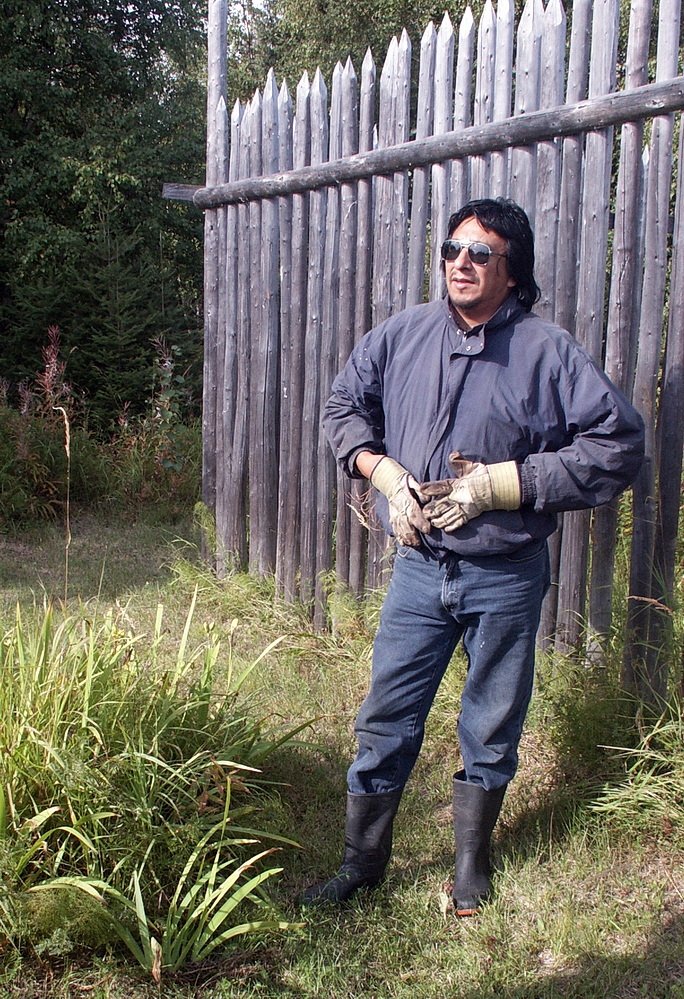
Photo 2: Eno H. Anderson (Kasabonika Lake First Nation), Deputy Chief at the time, standing outside the old Kasabonika community. Eno H. taught me that some Indigenous Knowledge keepers will never share their IK, not even with a member of their own Indigenous Nation. Photo composed by Andy Fyon, in the homeland of Kasabonika Lake First Nation, Ontario, Canada, August 28, 2003.
Medicinal Plant IK:
I am interested in the relationship between plants and geology. Early in our engagement with Marten Falls First Nation, I asked Chief Eli Moonias (Photo 3) about the names and uses of plants I recognized in the area. Chief Eli answered some questions and then said, “That is enough for today. Perhaps in the future it will be the right time to learn the answers to your questions.” I had not earned the privilege to learn more; I had not yet earned his trust.

Photo 3: Chief Eli Moonias (Marten Falls First Nation) sharing teachings about Indigenous Knowledge along the Albany River, northern Ontario, Canada. Photo composed by Andy Fyon, in the homeland of Marten Falls First Nation, Ontario, Canada, July 26, 2002.
Indigenous communities I engaged with in the Yukon, northern British Columbia, and Ontario between 2019 and 2025 requested that I disclose all the plants I had identified within their homelands. That plant list was reviewed by Elders and knowledge keepers to ensure I did not inadvertently disclose the locations and types of important or rare medicinal plants. I learned that the locations, types, and uses of medicinal plants were seldom shared because of concerns that commercial businesses would use that information to create medicines without any benefits being returned to the Indigenous community. Other communities feared that medicinal plants would be harvested by outsiders, depleting the supply for the Indigenous people. I was also told that the efficacy of a medicinal plant would be weakened by the presence of an outsider who visited those sites. Weakened efficacy by your presence? You may have difficulty accepting that concept, but it is a real concern for some Indigenous people.
Land-related IK:
Some IK keepers were reluctant to share knowledge about land resources of interest to miners or loggers because that knowledge could be used in a way that violated the community’s covenant with the Creator to protect the land. Or it could be used in a way that violated the community’s land-use values. Other knowledge keepers would not share the location of spiritual or special sites that might be visited by an outsider and used in a way that was disrespectful to a cultural or spiritual place or practice, such as the location of soapstone rock used to make ceremonial pipes. Again, I was told that the very presence of an outsider could weaken the power of that spiritual site.
Different Views of Protection:
In the settler world, we protect special sites by regulating activities, posting the site and controlling access or activities. Conversely, some Indigenous communities protect their special sites by keeping the existence and location confidential. I do not judge if one approach is better than another. You will likely encounter both approaches.
Health-related IK:
Regarding western health sciences, there is still reluctance on the part of some Indigenous people to participate in human genetic and medical studies because of the distrust created by past researchers who did not share study results, lacked transparency, and failed to engage in a meaningful way with the Indigenous community.
IK Conditions Vary:
Weiben Slipperjack (RIP; Eabametoong First Nation) taught me that conditions may accompany some types of shared IK, limiting its use or distribution. My mentor Andy Yesno (RIP; Eabametoong First Nation) and I, while traveling along the winter road to Fort Hope, came across Weiben in the bush. Weiben was proud to show us his traditional pine marten trap and allowed me to compose a photograph (Photo 4). I asked if it was acceptable to post the photo to help raise awareness about what I was learning. (Always seek permission!) He said it was acceptable to share the photo and story so long as I removed the marten trap from the image. I honour his request to this day. Contrast that perspective with the enthusiasm of Elder Josie Jacob (RIP; Webequie First Nation) who showed and described his hand-made, traditional hunting snowshoes (Photo 5). He had constructed them using different types of wood and animal gut to ensure they were light, strong, fast and quiet. When I asked if it was acceptable to share the photo of him with his snowshoes, he replied in the affirmative, happy in the knowledge that his skills and craft would be used to inform others.

Photo 4: Weiben Slipperjack (RIP; Eabametoong First Nation) beside his traditional hand- made pine marten trap. To protect his traditional knowledge, Weiben allowed me to post the photo and share his story, but asked that I digitally erase the trap. I honour his request to this day. Photo composed by Andy Fyon along the winter road, in the homeland of Eabametoong First Nation, Ontario, Canada, February 25, 2005.
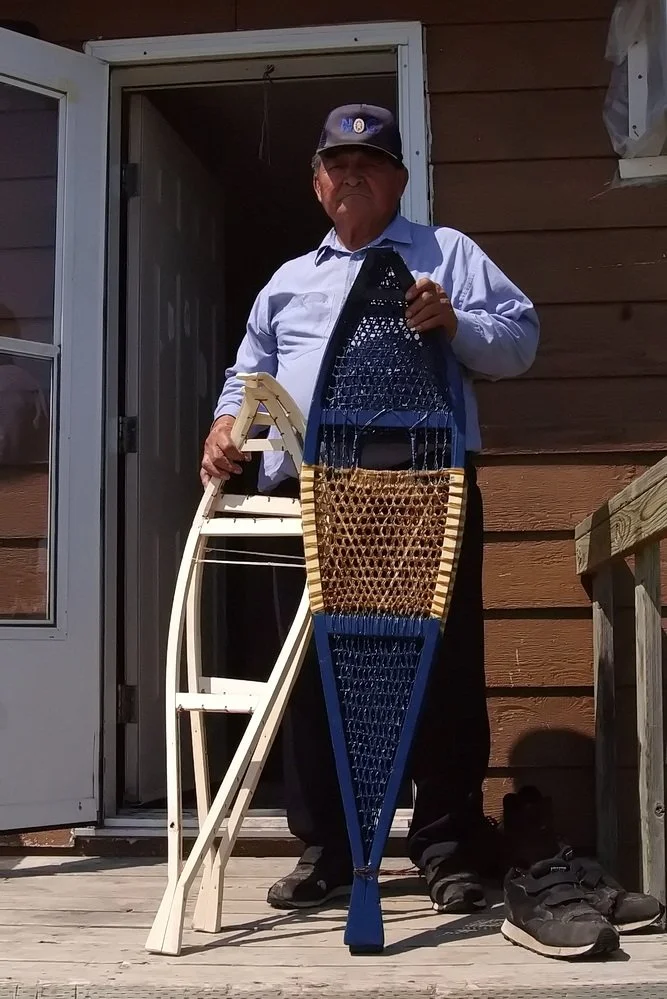
Photo 5: Elder Josie Jacob (RIP; Webequie First Nation) proudly showing us his hand-make hunting snowshoes. Photo composed by Andy Fyon, in the community of Webequie, in the homeland of Webequie First Nation, Ontario, Canada, June 1, 2006.
Some Practices:
I learned that earning the privilege to receive shared IK is part of a meaningful engagement process rooted in mutual respect, equality, and trust. That takes time to build. When shared, IK is a sacred resource that requires a special ethical approach. Here are some practices I was taught when dealing with the topic of access to IK:
Equality mindset: Adopt the mindset that IK is equal in status to Western science. If you do not come with that mindset, it is unlikely that IK will be shared with you.
Data governance: If IK is shared with you, determine if the community follows the Indigenous OCAP principles of ownership, control, access, and possession. During my career, I never heard a reference to OCAP or its principles, but every Indigenous community I engaged with embraced OCAP-like principles in different ways. It is critical to know if the knowledge keeper who shared their IK also has conditions on its use. Those conditions may not be articulated explicitly, so it is important to probe in order to find out or confirm. If you do not, you may inadvertently publish confidential IK. That is likely to put you and the relationship in a very precarious position.
Joint project development: A jointly developed project that incorporates IK helps ensure shared project ownership, with results that are meaningful and useful to the Indigenous community and incorporate IK in a respectful way consistent with the community adoption of OCAP or OCAP-like principles. Joint project development goes a long way to ensuring a mutual understanding of the IK use.
Open and transparent information-sharing: Explain your interests and how the IK you are seeking will be used. Give examples to illustrate why the IK is important to the project. Consider whether your perceived benefit represents a threat to the Indigenous community.
Reciprocity: Look for ways to link the project results to community priorities, such as land-use planning, health, or climate change monitoring, to ensure that the community benefits from the knowledge shared. If there is no benefit to the community, don’t be surprised if no IK is shared with you. Again, jointly developed projects are more likely to incorporate community interests and your interests.
Summary:
IK keepers taught me that they guard their knowledge. Some IK may never be disclosed. You have to earn the privilege to receive IK, which comes from the trust earned through meaningful engagement. If you earn the privilege to access IK, its use may be accompanied by conditions. It is critical to confirm what conditions, if any, accompany the IK. Discuss with the IK keeper how you will use the information. Will you publish it such that it becomes available to readers globally? How will you benefit from the IK? Will you make money selling it? What policy or regulatory decisions will be informed by the IK? Will those decisions disadvantage the Indigenous community? Are you planning to disclose to the community your use of the IK and the results achieved prior to publication? Remember, there are at least two contrasting answers to some of the questions.
In closing, I stress that your IK experiences will differ from mine. My experiences reflect the fact that: a) I am part of a white settler community whose reputation is not held in high regard by many Indigenous people; b) I was a leader of a geoscience organization in the Ontario provincial government and government is not always held in high regard by Indigenous people; c) the Indigenous communities I engaged with are located mostly in isolated geographic areas; their world views and customs may differ from communities in the south; and d) in the minds of many people, my training as a geologist is synonymous with mining. Change any of these parameters and you are likely to change the outcomes of your IK experience.
Andy Fyon: April 5, 2026