Walking Together: Blog 22: Building Trust with Indigenous People – Thinking: Part 6 of 6
In this part 6 of 6, the final note on building trust with an Indigenous community, I discuss Thinking. Recall, I am not an expert. I share lessons I learned from First Nations mentors living in Ontario’s far north so you don’t repeat the mistakes I made.
In case you have skipped Part 1 of this six part blog series, I learned there are five key pillars that underlie the journey of working toward mutual trust (Figure 1): a) engagement; b) empathy; c) authenticity; d) thinking; and e) communication. Check out the other notes of this six part blog series to gain insights about the other Trust-related topics.
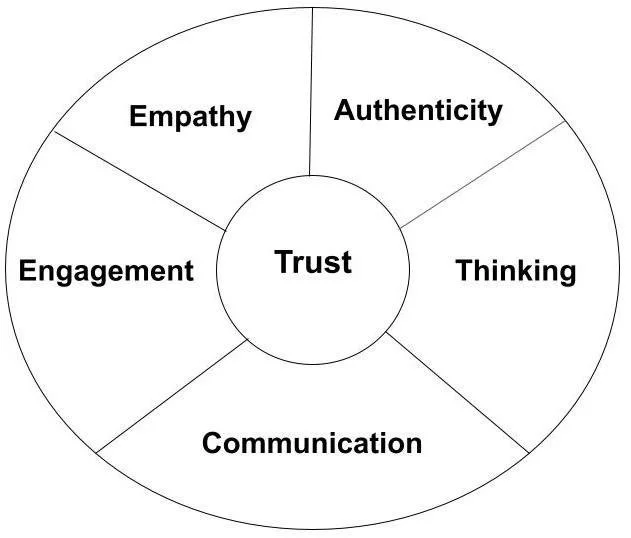
Figure 1: Some processes and skills (Engagement and Communication) and behavioral competencies (Empathy, Authenticity, and Thinking) that form the pillars of building trust with an Indigenous community.
Dr. Frances Frei, a professor of technology and operations management at the Harvard Business School, reminds us that failure to think clearly can reveal itself in at least two ways: a) the quality of our thinking; or b) our inability to effectively communicate our thinking. Regarding the quality of our thinking, people quickly realize if we are incompetent, incapable of thinking critically, unable to identify and address issues, or incapable of listening to inform and modify our thinking. People also quickly discover if we don’t know what we are talking about, if others do not trust our ideas and judgment, if we focus on positions instead of interests, if our thinking is prejudiced or racist, or if we are unable or unwilling to understand the interests of others. In these circumstances, it is hard to build trust because people will ignore or dismiss you. But, if you are a leader of an organization or a research project, you likely have the right thinking skills. So, generally, it is not the thinking skills that let you down, it may be your inability to listen and effectively communicate what you are thinking to the audience.
Regarding our ability to think, it is hard to self-diagnose our own thinking skills. So, ask a trusted source, or better still, ask the following questions of an Indigenous person from the community you are engaging with:
have I demonstrated that I think clearly?;
do I listen?;
do I understand your interests?;
are my thoughts prejudiced or racist? Do they show gender bias? Are they influenced by stereotypes?
If you demonstrate tendencies or have acquired a reputation, REAL or PERCEIVED, of flawed, deceptive or prejudiced thinking, you will likely falter and the organization you represent will likely be branded with that same reputation. It will be hard to build trust (see A3 Invest in Building Relationships in Walking Together).
Early during my engagement journey, I was told by a person working for a First Nation band, who had many years of experience, that my thinking was clouded and likely biased by institutional perspectives that would make it hard to develop a meaningful relationship with a First Nations community. After much thought, I realized she was correct. That changed my thinking. I started looking and then seeing the world in a different way that included the First Nations perspectives along with my own. Mi'kmaw Elder Albert Marshall of the Eskasoni First Nation, Nova Scotia, Canada, called that concept Two-Eyed Seeing (Etuaptumumk in the Mi'kmaq language). It is a concept that brings together Indigenous and Western worldviews to consider issues from multiple viewpoints. Elder Marshall describes the concept as "to see from one eye with the strengths of Indigenous ways of knowing, and to see from the other eye with the strengths of Western ways of knowing, and to use both of these eyes together".
That caused me to undertake different discussions within the Ontario Geological Survey (OGS), the geoscience organization I lead (Figure 2), and the leaders of the Ontario government ministry we belonged to Figure 2). While I had no authority to make the policy and regulatory changes requested by the First Nations, I did advocate for those changes, explained possible consequences of the status quo, and began to implement changes within my scope of authority within the OGS.

Figure 2: Andy Yesno, Eabametoong First Nation, Ontario, twice met with government staff on the Ontario Ministry of Northern Development and Mines to share insights about his life and to address questions. This was the first step of effecting organizational cultural change. Photo composed by Lori Churchill, Willet Green Miller Centre, Sudbury, Ontario, July10, 2002.
In short, my thinking changed. I began to see the worlds differently.
Andy Fyon: March 10, 2026.